- November 17, 2026
Parking lot striping looks simple, but it affects safety, traffic flow and legal compliance for every commercial property in North Georgia. Faded lines confuse drivers, and a wrong layout can fail an inspection even when the paint looks fresh. This guide shows you how to plan your lot so the markings meet federal rules, Georgia rules and local requirements.
We cover space counts, dimensions, signs, routes, materials, costs and timing. You will also find tables, checklists and links to deeper guides on each major topic.
Who Must Follow ADA Parking Requirements in Georgia
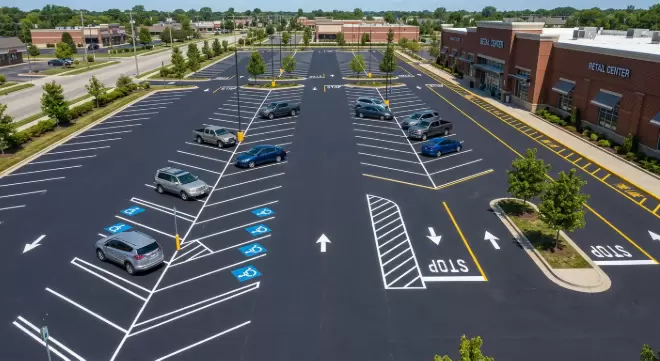
ADA parking requirements apply whenever a government, business or nonprofit provides a parking lot or garage for other people to use. That includes retail centers, offices, restaurants, medical offices, churches, schools, hotels and the common areas of apartment communities.
The Rulebooks That Matter
Georgia’s statewide accessibility rule adopts the 2010 ADA Standards for Accessible Design for covered public and commercial facilities. The same rule treats resurfacing, restriping and repainting of a parking facility as a form of renovation.
| Requirement area | Primary source | What it governs |
|---|---|---|
| Space count, dimensions, aisles, slopes and signs | 2010 ADA Standards, Sections 208 and 502 | Federal accessibility minimums for parking |
| Georgia accessibility adoption | Georgia’s statewide accessibility rule | Minimum standards for covered public and commercial facilities |
| Disability parking identification | O.C.G.A. Title 40, Chapter 6, Article 10, Part 2 | State rules for identifying and enforcing accessible spaces |
| Traffic control markings | Federal MUTCD | National standards for signs and markings on public roads and open site roadways |
| Zoning, fire and permits | Local authority having jurisdiction | Fire lanes, curbs, drainage, approvals and inspections |
No Single North Georgia Code
There is no one striping code for all of North Georgia. Rules can differ among Atlanta, Marietta, Alpharetta, Roswell, Cumming, Gainesville, Dahlonega, Cartersville and unincorporated counties.
Always confirm the final layout with the local building department and fire marshal before any paint touches the pavement.
ADA Compliance for Parking Lot Striping in Georgia
Strong ADA compliance for parking lot striping starts with the physical space, because a painted symbol alone proves nothing. The stall, aisle, route, slope, surface and sign must all meet the standards at the same time.
Paint Is Only One Piece
Correct striping makes an accessible parking program visible. It does not make a lot compliant by itself, so owners should verify each item in the list below.
-
The number of accessible spaces and the van accessible ratio must match the federal count table for that lot.
-
Every stall and access aisle must meet the minimum width, and the aisle must match the length of the stall.
-
Slopes must stay within limits, and the surface must remain firm, stable and slip resistant.
-
The accessible route must lead to a usable entrance without steps, steep curbs or loose gravel.
-
Every accessible space needs a compliant sign that remains visible above parked vehicles.
Federal and Local Rules Work Together
ADA rules set the minimum, and local fire and zoning rules sit on top of it. A city may add requirements, but it can never lower the federal count.
How Many Accessible Spaces Does Your Lot Need
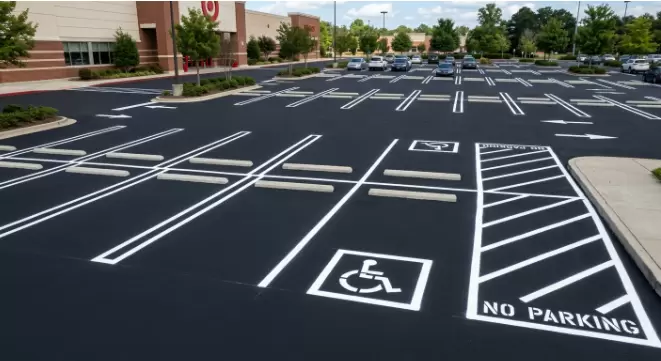
Calculate the requirement separately for each parking lot or garage, using only the total spaces in that one facility. Do not add the spaces from several lots together.
The Standard Count Table
| Total spaces in the facility | Minimum accessible spaces |
|---|---|
| 1 to 25 | 1 |
| 26 to 50 | 2 |
| 51 to 75 | 3 |
| 76 to 100 | 4 |
| 101 to 150 | 5 |
| 151 to 200 | 6 |
| 201 to 300 | 7 |
| 301 to 400 | 8 |
| 401 to 500 | 9 |
| 501 to 1,000 | 2% of total spaces |
| 1,001 and over | 20 plus 1 for each 100 or fraction over 1,000 |
Van Accessible Spaces
At least 1 of every 6 accessible spaces, or fraction thereof, must be van accessible. A lot with only one accessible space must make that space van accessible.
A lot with four or fewer total spaces must still provide one van accessible space. A sign is not required in that limited case.
Quick Examples
-
A 40 space retail lot needs 2 accessible spaces, and 1 of them must be van accessible.
-
A 600 space garage needs 12 accessible spaces, and at least 2 of them must be van accessible.
-
A 60 space lot and a 140 space lot on one property need 3 and 5 accessible spaces. A combined count of 200 would give only 6.
Special Facility Counts
Some property types face higher minimums than the standard table.
| Facility type | Share of patient and visitor spaces |
|---|---|
| Hospital outpatient facilities | 10% accessible |
| Rehabilitation facilities | 20% accessible |
| Outpatient physical therapy facilities | 20% accessible |
Residential projects follow different rules tied to unit counts and housing type. A property with valet service generally needs an accessible passenger loading zone as well.
For a full walkthrough of counts and special cases, read our guide [How Many ADA Parking Spaces Are Required? (2026 Guide)].
ADA Parking Striping Layout and Dimensions
Accurate ADA parking striping depends on measuring the finished clear dimensions, not only the width of the paint. Larger dimensions are allowed, but smaller ones are never acceptable.
Minimum Stall and Aisle Sizes
| Element | Minimum requirement |
|---|---|
| Standard accessible car space | 96 inches (8 feet) wide |
| Standard access aisle | 60 inches (5 feet) wide |
| Van space, first option | 132 inches (11 feet) wide with a 60 inch aisle |
| Van space, second option | 96 inches (8 feet) wide with a 96 inch aisle |
| Access aisle length | Same length as the parking space |
| Vertical clearance on van routes | At least 98 inches |
| Surface | Firm, stable and slip resistant |
| Slope | No more than 1:48, or 2.08%, in any direction |
Access Aisle Rules
-
Access aisles are not extra parking space, and they must stay level with the stall. They must be marked clearly so drivers know not to park inside them.
-
Two accessible spaces may share one access aisle when the aisle sits between them, except in angled parking.
-
In angled parking, the access aisle must sit on the passenger side of the space.
-
An access aisle may sit on either side of a perpendicular space unless the angled rules apply.
-
The ADA requires the aisle to be marked but does not prescribe one exact hatch pattern.
Line Width and Colors
Where lines mark the spaces, width measurements are taken from the centerline of the paint. Many crews use 4 inch lines, but the finished clear dimension is what matters.
Blue is common for the accessibility symbol, white for stall lines and yellow for certain no parking markings. For private lots, confirm color and symbol practices with the local fire marshal and building office.
Standard Marking Elements
A well planned commercial lot usually includes several types of pavement markings.
-
Stall lines, accessible symbols, access aisle hatching and van accessible pavement text where the site uses it.
-
Directional arrows, stop bars, crosswalks and pedestrian routes that guide drivers and walkers safely.
-
Loading zones, curb markings, no parking areas and fire lane markings approved by the local fire marshal.
Location, Accessible Route and Signage
Accessible spaces must sit on the shortest accessible route to an accessible entrance. When a lot serves several entrances, spread the spaces among them instead of grouping them at one end.
Accessible Route Basics
Striping cannot fix a bad location. If the closest route leads to steps or a steep curb, the layout may still be noncompliant.
-
The route must be at least 36 inches wide with a firm, stable and slip resistant surface.
-
It must avoid stairs and curbs unless a compliant curb ramp or another accessible transition is provided.
-
The slope in the direction of travel must not exceed 1:12.
On sloped North Georgia sites, the route is often the most expensive compliance issue. A stall can be striped perfectly and still fail if the path to the door is too steep.
Sign Requirements
Every accessible space needs a vertical sign with the International Symbol of Accessibility. The bottom of the sign must sit at least 60 inches above the ground.
Van accessible spaces need an added sign or designation stating “van accessible.” Signs must remain durable, legible and clear of landscaping, dumpsters and parked vehicles.
Repainting the pavement does not fix a missing or wrong sign. Replace faded, bent or low signs during every restriping project.
When Parking Lot Striping Triggers ADA Updates
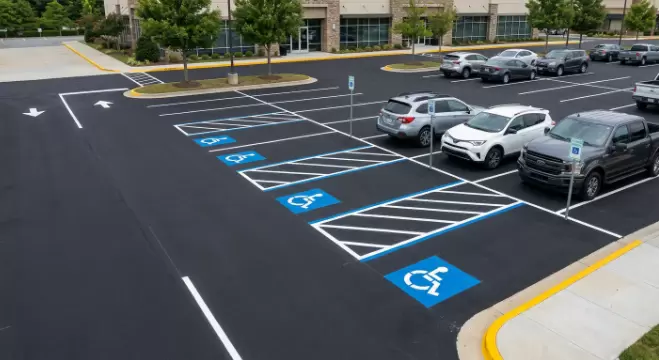
Georgia includes parking facility restriping and repainting in its definition of renovation. Federal guidance also says a business that restripes must provide accessible parking as the standards require.
Events That Call for a Review
Review your accessible spaces whenever any of these events happens on your property.
-
The lot is new, altered, resurfaced, restriped or repainted.
-
The building entrance, tenant mix or accessible route changes.
-
The total number of parking spaces changes.
-
Settlement, cracking or drainage creates slope or surface problems.
-
Signs are missing, faded, damaged or mounted too low.
-
A complaint, inspection or insurance review points to an access issue.
Georgia Enforcement
Georgia law expects owners who must provide accessible parking to designate each required space properly. Failure can bring a $150 fine per space, and the fine may be waived if the owner corrects the issue within 14 days. After the fifteenth day, an extra $5 per space can build up each day until the markings are fixed.
Marking Materials and Surface Preparation
The right material depends on traffic, weather and budget. Fresh paint over cracked, dirty or damp asphalt will fail early, so preparation matters as much as the paint.
Common Materials
| Material | Best use | Notes |
|---|---|---|
| Water based traffic paint | Routine restriping | Fast application and lower cost, with durability that varies by traffic |
| Solvent based traffic paint | High durability needs | May face local limits on emissions and weather |
| Thermoplastic | Crosswalks, symbols and busy lanes | More durable and reflective but usually costs more |
| Epoxy or two part coatings | High wear commercial areas | Needs careful surface preparation and curing conditions |
| Preformed tape or symbols | Accessible symbols and arrows | Consistent look, but adhesion depends on pavement condition |
Thermoplastic Pros and Cons
Pros
-
It lasts several years in busy lanes and crosswalks, which reduces repeat visits from the crew.
-
It works well for stop bars, symbols and fire lanes where the fire marshal approves it.
Cons
-
It costs much more upfront than water based paint, which matters for quiet retail and office lots.
-
Its lifespan still depends on traffic, weather and the quality of the application.
Preparation Checks
A good contractor checks pavement cleanliness, dryness, temperature and repair condition before application. Repair cracks and failing asphalt first, because paint will not hold on crumbling surfaces.
Striping After Sealcoating
Sealcoat covers every old line, so accessible spaces and fire lanes must be restored once the surface cures. Most warm and dry lots can be striped after about 24 hours, while cool, humid or shaded lots need 48 to 72 hours. Our guide [Striping After Sealcoating: Timing & Sequencing Explained] covers the correct work order and readiness checks.
Fire Lanes and Local Rules in North Georgia
ADA compliance does not replace fire code or zoning rules. Fire lane width, signs, curb color and enforcement wording are often set by the local fire marshal, so never copy a design from another county.
Marietta as a Local Example
Marietta shows how much local rules can add to the federal baseline. A contractor should never reuse a layout from another city without checking the approved site plan.
| Item | Marietta requirement |
|---|---|
| Standard parking space | At least 9 feet wide and 20 feet deep, excluding passageways |
| Accessible space count | Must follow the federal ADA count table |
| Access aisle | One 96 inch aisle for every two 9 foot accessible spaces |
| Accessible space slope | No steeper than 1:48 in any direction |
| Accessible space sign | Blue reflective sign, at least 12 by 18 inches, with the bottom 7 feet above ground |
| Sign wording | Symbol plus “Permit Parking Only” and “Tow Away Zone” |
Marietta’s checklist lists one van layout as 108 inches wide with a 96 inch aisle. The federal standards use 96 inches wide with a 96 inch aisle, so use the federal layouts unless the city approves a different detail in writing.
Marietta Fire Lane Details
Fire lane markings in Marietta must follow the approved fire access plan instead of being painted as a cosmetic item.
-
Fire access roads generally need an unobstructed width of 20 feet and vertical clearance of 13 feet 6 inches.
-
The road width rises to 26 feet where a hydrant sits on the access road.
-
Signs are mounted 7 feet high at the start, at the end and every 50 linear feet of the fire lane.
Who Reviews Your Layout
Marietta Planning and Zoning reviews parking counts and layout, while the Fire Marshal’s Office reviews fire lanes, hydrants and signs. Public works may also review curb cuts and drainage. For a new layout, a licensed site civil engineer or architect should confirm the plan.
Fire lane colors, stencil wording and sign spacing differ across Atlanta, Gwinnett, Hall and other jurisdictions. Our guide [Fire Lane Stenciling and Sign Rules for North Georgia Properties] explains these differences in detail.
Costs, Timing and Restriping Schedule
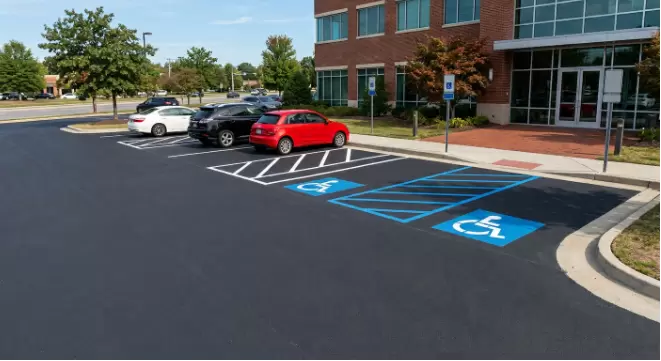
Most small and medium commercial lots in North Georgia fall between $400 and $1,400 when the crew uses standard water based paint. Your quote depends on stall count, whether lines already exist and how many ADA spaces you need.
Typical Prices
| Project type | Typical cost |
|---|---|
| Basic restripe following existing lines | $4 to $8 per stall |
| New layout with measuring and chalk work | $6 to $12 per stall |
| Standard 4 inch line | $0.20 to $0.60 per linear foot |
| Job minimum | $300 to $800 |
Added Marking Costs
| Marking | Typical added cost |
|---|---|
| ADA space with symbol and hatched aisle | $25 to $60 each |
| Directional arrow | $8 to $20 each |
| Word stencil such as STOP | $18 to $35 each |
| Fire lane, crosswalk or stop bar | $150 to $350 or more |
A 50 stall lot usually costs $500 to $800 for a basic restripe and $600 to $1,400 with ADA spaces and arrows. Our guide [How Much Does Parking Lot Striping Cost?] includes lot size tables and a simple budget formula.
How Often to Restripe
No law sets a fixed repaint date for private lots, so condition should trigger the work as much as the calendar. Most commercial lots need fresh paint every 12 to 24 months.
| Property type | Suggested interval |
|---|---|
| Grocery, retail, restaurant, fuel and busy medical | Every 12 to 18 months |
| Office, apartment and mixed use | Every 18 to 24 months |
| Low traffic overflow and storage yards | Every 24 to 36 months if lines stay clear |
Accessible aisles, symbols and fire lanes should be touched up as soon as they fade. Our guide [How Often Should You Restripe a Parking Lot?] explains wear factors and warning signs.
Approval and Documentation
Do not rely on a striping contractor alone for legal compliance. The owner, designer or site engineer should confirm the approved plan with the local jurisdiction before work begins.
Questions for the Local Authority
-
Is a striping or pavement marking permit needed for this project?
-
Does a layout change require a site plan revision?
-
Does the city or county have accessible parking rules stricter than the ADA?
-
What are the fire lane width, sign and curb marking requirements?
-
Is an inspection required before occupancy or project closeout?
Your Compliance File
Keep one file for each parking facility, because ADA compliance depends on the facts of each lot. If a complaint arises, you can show the correct counts, sizes, route, signs and maintenance history.
-
The approved site plan, total space count, accessible count and van space count.
-
Dimensions for every accessible stall and aisle, plus slope measurements.
-
Sign details, installation photos and paint or material specifications.
-
Contractor proposals, invoices, warranties, permits and fire marshal letters.
-
Inspection reports and a log of restriping and repairs.
Common Compliance Mistakes
These errors often lead to failed inspections and costly rework.
-
Counting accessible spaces across several lots instead of calculating each lot or garage separately.
-
Providing enough accessible spaces but too few van accessible spaces for the total.
-
Painting an 8 foot stall without the required 5 foot access aisle beside it.
-
Letting cars park in aisles because the hatching is faded or was never marked clearly.
-
Placing accessible spaces far from the entrance or along a route that fails the standards.
-
Ignoring slope after asphalt repairs, since a patch can push a stall past the 2.08% limit.
-
Mounting signs below 60 inches or allowing landscaping to block them from view.
-
Repainting old lines without correcting a layout that was noncompliant from the start.
-
Losing the 98 inch vertical clearance on van routes near awnings, pipes and low structures.
Additional Considerations
-
Inspect accessible stalls, aisles, signs and routes at least once each quarter, and photograph the markings afterward.
-
Recheck slopes after any paving repair, because small grading errors can quietly create a compliance problem.
-
Ask every bidder for an itemized quote that separates stall, ADA, arrow and minimum charges.
-
Confirm that each bid includes access aisles, symbols and signs, since a low price may leave them out.
-
Verify insurance coverage and familiarity with the 2010 ADA Standards and Georgia rules before signing a contract.
-
Schedule work from spring through early fall, when warm dry weather helps paint cure properly.
Final Words
Good parking lot striping protects your visitors, keeps your property inspection ready and helps you avoid expensive repainting. Count each lot separately, verify the design details and get local approval before work begins.
We have guided many property owners through this process, and we are ready to help you plan yours. New Pointe Contracting is an asphalt paving and concrete contractor serving residential and commercial customers across North Georgia. With years of experience and more than 3,000 completed projects, we serve Marietta, Alpharetta, Roswell, Woodstock and Acworth. Call us at 404-414-7192 for enquiries and paving project estimates.